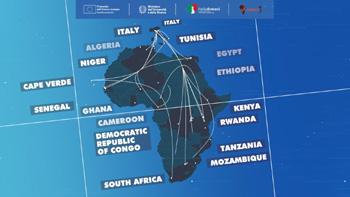
The ACHIEVE-IT project (Academic Collaboration through Higher International Education for a Viable and Equitable Africa with Italy, https://www.unimore.it/it/internazionalizzazione/mobilita-pnrr-tne) is an international cooperation initiative in higher education between Italy and Africa, developed within the framework of the PNRR – TNE program. This project aims to strengthen academic relations in line with the objectives of the AU-EU Innovation Agenda, involving a consortium of seven Italian universities, including UNIMORE, and 37 African institutions across 16 partner countries. The main goal is to enhance the presence of Italian universities on the African continent by promoting long-term, sustainable collaborations in higher education and research. ACHIEVE-IT supports academic mobility, knowledge exchange, and educational cooperation through an innovative and scalable approach. The video summarizing the actions undertaken by the ACHIEVE-IT project is available at the following link https://youtu.be/pPOeLAYQxY0
The FOCUSER project (Food Campus Education & Research) is a high-profile initiative funded by the Italian Ministry of University and Research (MUR) under the Legacy Expo 2020 Dubai framework (https://organismi.unicatt.it/trofic/it/progetti/food-campus-education-research--focuser-.html). Led by Università Cattolica del Sacro Cuore in partnership with the Universities of Bologna, Parma, Ferrara, and UNIMORE, the project spans 60 months (2024-2029). For UNIMROE, the coordinator is Prof. Giuseppe Montevecchi. It aims to create an international inter-university campus for food processing innovation, fostering a strategic partnership between Italy and the MENA region (Middle East and North Africa).
The initiative is built upon three core elements:
1. Multi-stakeholder platform: a collaborative network involving research centers, industries, and institutions to identify the scientific and soft skills required for sustainable food transformation and to accelerate innovation transfer to the Mediterranean production sector.
2. Research and innovation (transferable to MENA): multi-disciplinary research focused on food safety, sustainable technologies, and waste reduction. These activities utilize the laboratories and pilot plants of the partner universities to enhance food system resilience and security across the MENA area.
3. Higher education and mobility: the establishment of an academic center of excellence offering post-graduate programs through hybrid learning. The project promotes international mobility for PhD candidates and visiting professors, ensuring a direct link between advanced research and specialized education.
The project Green&Pink for Sustainable Education – GPS Education, led by the University of Foggia, involves nine Italian universities and forty-one partner institutions across Latin America, Africa, Asia, and Europe (https://gpsedu.org/, https://www.unimore.it/it/internazionalizzazione/mobilita-pnrr-tne). The initiative aims to strengthen global academic cooperation and develop continuing education pathways focused on sustainability, explored through environmental (GREEN), digital, and social dimensions, with particular attention to gender equality (PINK) and the empowerment of young people.
Among the Italian partners, UNIMORE participates through three departments (DSV, DIEF and DISMI). The scientific coordinator for UNIMORE is Prof. Enrico Francia (DSV), who oversees the three thematic areas, i.e. sustainable management of agro-ecosystems (DSV), environmental chemistry and circular economy (DIEF), and models and algorithms for logistics and production (DISMI).
The project funds student and staff mobility, the creation of jointly coordinated educational hubs, and shared training activities. For UNIMORE, it also represents an opportunity to consolidate ongoing collaborations with partner universities in Argentina and Brazil, where incoming and outgoing mobility schemes for doctoral/master students and academic staff are planned.